
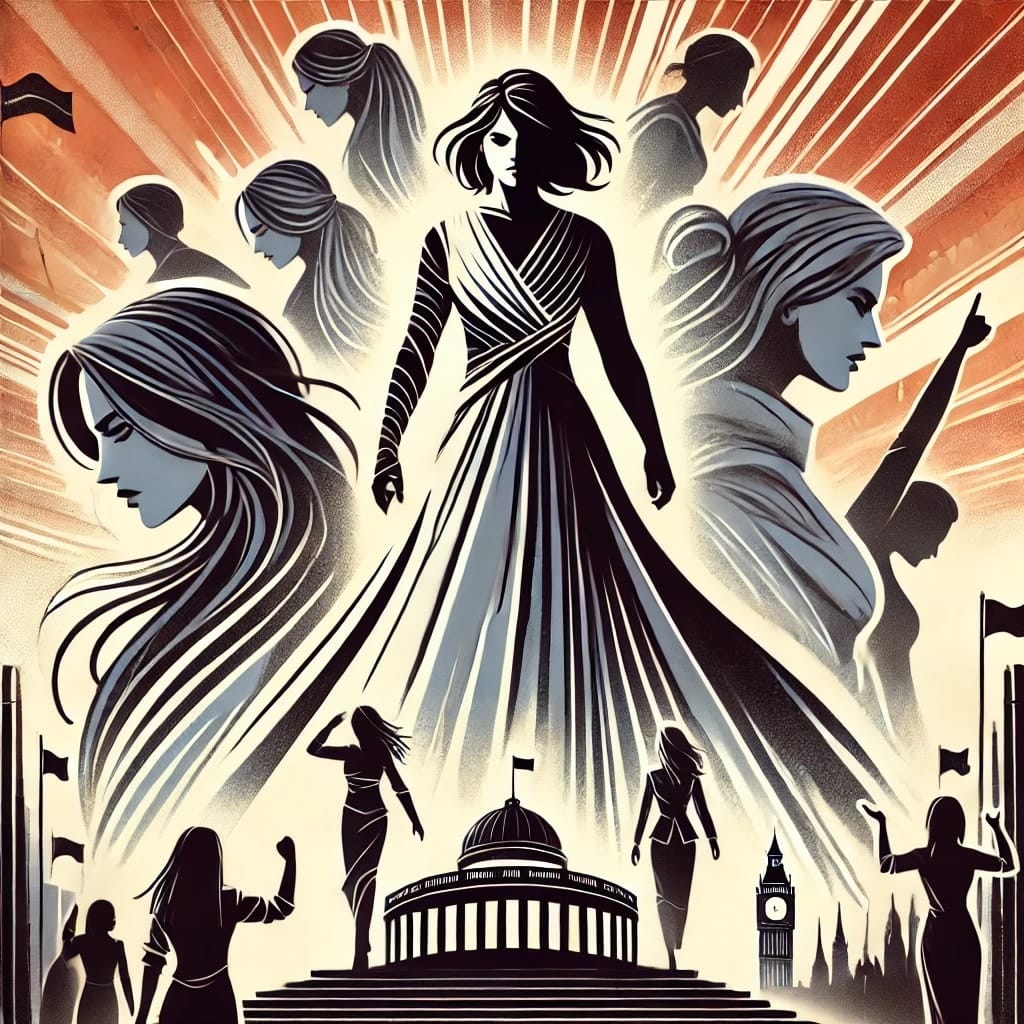
Women and political power represent not only an external struggle for representation but also an inner odyssey of courage, resilience, and transformation. In a world where heroic narratives are still dominated by male figures, it is crucial to redefine the Hero’s Journey so that it reflects women’s experiences.
The initiatory journey is not the privilege of men. It is a universal quest for transformation, self-discovery, and overcoming obstacles—one that belongs equally to women. Through my writings and professional observations, I have witnessed how women, although underrepresented in spheres of power, carry immense inner strength, often revealed in extraordinary circumstances.
Women and Political Power: Redefining Heroism
Heroism, as traditionally conceived, is often associated with physical bravery, conquest, and battles against tangible enemies.
Yet for women, heroism often takes on a more subtle, though equally powerful, form. It may be resilience in the face of personal and professional challenges, resistance to unjust systems, or the pursuit of integrity in a world that can be hostile.
For many, the true Hero’s Journey begins when they choose to assert themselves in environments designed to marginalize or control them. This journey is an inner odyssey—a struggle to preserve dignity, defend ethics, and claim their rightful place in a world that often seeks to silence them.
In this sense, women and political power are deeply connected. Heroism is not just about battles on the outside—it is also about courage on the inside.
Women and Political Power: Inner Strength Against Domination
In power structures largely controlled by men—whether in public or private life—the hunger for domination becomes corrosive. It corrupts not only institutions but also human relationships.
Women, often perceived as peripheral actors in these environments, must draw upon inner strength to navigate such troubled waters. This strength manifests in the ability to say no to injustice, to stand against corruption, and to act in spite of threats, whether overt or insidious.
This courage and determination form the very essence of the Hero’s Journey for women. It is not only about survival but about transformation: turning pain into power, oppression into action, and obstacles into stepping stones toward greater freedom.
This shows that women and political power cannot be separated from the question of ethics. When women bring their inner strength into politics, they challenge systems built on domination and open the way to transformation.
My Testimony: Women’s Strength in the Face of Adversity
Through my three books, inspired by lived experiences in international organizations and as an adviser to governments, I have sought to illustrate this initiatory journey of women.
In Women Among Wolves, the heroine Anaïs leaves behind an ordinary life to face a world steeped in corruption and manipulation. She discovers within herself a hidden strength that propels her to fight for justice.
In The Golem Project: Shadows of the Mind, the myth of the Golem becomes a metaphor. A woman, confronted with dark forces and destructive powers, finds the courage to resist—mirroring the power struggles I witnessed throughout my career.
Finally, my political essay United Nations: An Analysis of Democratic Drift exposes corruption within international organizations. It reflects on the crucial role women must play in restoring ethics within such structures.
Each work highlights how ordinary women, often ignored in power circles, can become heroines when they discover and use their inner strength in the face of extraordinary challenges. These stories show again and again that women and political power are part of the same larger narrative.
Overcoming Obstacles: Toward Greater Female Participation in Politics
It is undeniable that women still hold far too few leadership positions in politics. Too often, they face hostile and sexist environments.
The reasons for this underrepresentation are many: systemic sexism, discrimination, difficulties in balancing private and professional life, lack of support networks, self-censorship, and political violence. Yet these obstacles can be overcome.
First, it is essential to create more inclusive political environments where women feel respected and supported. Political parties must take concrete measures to encourage women’s participation. Examples include establishing gender quotas, creating policies that help balance work and family life, and actively fighting sexism and violence in politics.
Strengthening support networks is equally crucial. Mentoring, leadership training, and professional opportunities can empower women to rise. These initiatives show how women and political power can be linked through collective structures of support.
Self-confidence is another key factor. Encouraging women to believe in their abilities and step forward—even in hostile environments—is fundamental. Female role models in politics serve as examples and inspiration.
Finally, we must change the perception of politics itself. Instead of being seen only as a battleground of domination, it should be seen as a platform for positive transformation. Here again, women and political power create the potential for governance that is more just and effective.
Cultural Change and Structural Solutions
Solutions exist to initiate cultural and political change. They include:
- Educational programs and awareness sessions.
- Promotion of positive female role models in politics.
- Strengthening women’s networks and mentorship opportunities.
- Transformation of political parties and their culture.
- Fighting stereotypes and stigmatization.
- Launching women’s leadership programs.
- Engaging male allies as partners.
But all these solutions depend on a deeper shift: a change in mindset among women themselves. When women fully embrace their capacity for leadership, the relationship between women and political power is transformed from aspiration into reality.
Women and Political Power in the Fight for an Ethical World
Women are not mere spectators in the dynamics of power. They are essential actors in the struggle for a more ethical and just world.
In this context, the Hero’s Journey becomes a collective mission to eradicate corruption, restore balance within power structures, and create spaces where respect, justice, and solidarity prevail.
Through their commitment and refusal to conform to the dictates of a power-hungry world, women can transform institutions from within. Their contribution is indispensable to building a future where ethics are not only preached but lived.
This proves that women and political power are central to building ethical leadership for the 21st century.
Conclusion: Women and Political Power as a Beacon
When the Hero’s Journey is reappropriated by women, it becomes a powerful testimony to their ability to overcome obstacles and bring about lasting change.
This is not merely an individual quest. It is a call to all women to believe in their power of transformation. The message I wish to convey through my writing and experience is simple: nothing is impossible for women, even in the face of overwhelming male dominance.
Women and political power are inseparable in the struggle for justice and ethics. Women not only have the ability but also the responsibility to play a central role in reshaping politics and leadership.
Their journey is a beacon of light for all who seek to carve their own path in a world that too often resists change.
References & Further Reading
Campbell, J. (1949). The Hero with a Thousand Faces. Princeton University Press.
👉 Princeton University Press – The Hero with a Thousand FacesMurdock, M. (1990). The Heroine’s Journey. Shambhala Publications.
👉 Shambhala – The Heroine’s JourneyUN Women (2023). Women in Politics: 2023 Map.
👉 UN Women – Women in Politics MapInter-Parliamentary Union (IPU). Data on Women in National Parliaments.
👉 IPU Data – Women in ParliamentKrook, M. L. (2020). Violence Against Women in Politics. Oxford University Press.
👉 Oxford University Press – Violence Against Women in PoliticsOECD (2021). Gender Equality in Public Life.
👉 OECD – Gender Equality in Public LifeTransparency International. Women and Corruption: Integrity and Accountability.
👉 Transparency International – Women and CorruptionDollar, D., Fisman, R., & Gatti, R. (2001). Are Women Really the “Fairer” Sex? Corruption and Women in Government. Journal of Economic Behavior & Organization, 46(4), 423–429.
👉 ScienceDirect – Are Women Really the “Fairer” Sex?Catalyst. Women in Leadership: Quick Take.
👉 Catalyst – Women in LeadershipEagly, A. H., & Carli, L. L. (2007). Through the Labyrinth: The Truth About How Women Become Leaders. Harvard Business Review Press.
👉 Harvard Business Review Press – Through the Labyrinth