
Academic Research
Transpersonal Psychology · Consciousness · Spiritual Intelligence
Exploring the frontiers of inner transformation through rigorous academic inquiry.
Welcome to this space dedicated to my research in transpersonal psychology.
For over twenty years, I have been exploring what drives human beings — their behaviors, values, resistances, and impulses toward transformation. Here I share the fruit of my readings, academic work, and field experience, as well as my intuitions, where scientific rigor meets inner listening.
You will find articles, reading notes, essays, and reflections at the crossroads of psychology, spirituality, leadership, consciousness, and collective and spiritual intelligence.
My wish: to nurture dialogue, awaken consciousness, and open new perspectives for action.

Life as a Quest for Meaning: Organic Inquiry
All human beings have had difficult or traumatic experiences at some point in their lives. For some religions, this is part of human beings’ destiny since they were expelled from paradise after they disobeyed God and ate the fruits of the tree of knowledge or good or evil. Since that tragic moment, the individual must experience bodily suffering. But strangely enough, not everyone has the same capacity to cope with it. Some people are desperate, while others are more resilient. Viktor Frankl taught us that only by understanding the meaning of suffering can we overcome it. This is a position I share. In this essay, I will draw on my personal experience and my embodied practice of traveling to explore what mechanisms of resilience I put in place when facing traumas and how life’s challenges can shape a life
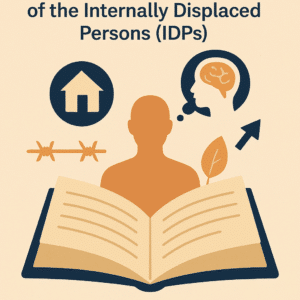
Somatic Psychotherapy Approach of the Internally Displaced Persons (IDPs)
Armed conflicts have never stopped in the world and a large part of the globe still experiences armed confrontations today. According to the Armed Conflict Location and Event Data Project (ACLED), the number of battles and violence against civilians has increased again in 2022 compared to 2021. At the end of 2021, the number of people uprooted by war, violence, persecution, and human rights violations stood at 89.3 million, an 8% increase over the previous year and well over double the figure from a decade ago, according to UNHCR’s annual Global Trends Report. As of May 2022, more than 100 million people were uprooted worldwide due to persecution, conflict, violence, human rights violations, or serious disruption of public order. Not only uprooted people lose their bearings, but also their social status, creating immense stress for individuals and their families, including their descendants through memory transmission. This paper is on the contribution of somatic psychology to the traumas inherited from uprooted people at an individual and a collective level.
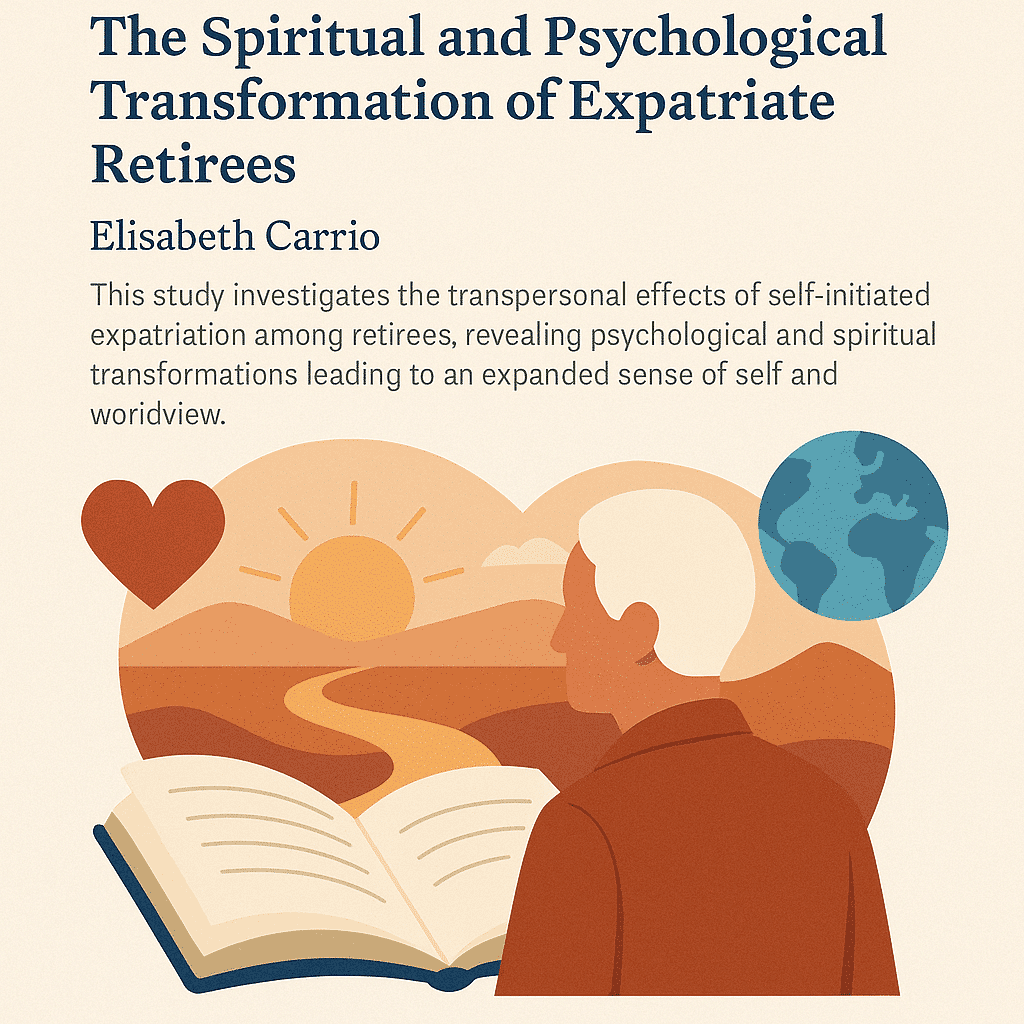
Transcending Boundaries: The Spiritual and Psychological Transformation of Expatriate Retirees
This study investigated the transpersonal effects of self-initiated expatriation among
retirees, a phenomenon increasingly significant in today’s globalised world. The
research contextualised expatriation within a broader exploration of retirees’ pursuit
of a better quality of life, cultural enrichment, and personal growth, situating these
motivations within the existing literature on ageing and transpersonal psychology.
Employing organic inquiry, a method that captures deeply personal and transformative
experiences, and looking into the experiences of four expatriate retirees, the study
revealed four key themes: the initial call to expatriation, identity reformation through
cultural immersion, the challenges of cultural integration, and the psychological
rebirth characterised by gerotranscendence. Findings suggest that expatriation in
retirement leads to profound psychological and spiritual transformations, fostering
a redefined sense of self and an expanded worldview. These insights contribute to a
deeper understanding of the psychological and spiritual dimensions of retirement and
ageing, challenging traditional narratives and offering new perspectives for scholars,
policymakers, and individuals considering expatriation. The study fills a critical gap
in the literature by providing a nuanced exploration of the personal and transpersonal
consequences of expatriation.

From Fragmentation to Coherence:
A Conceptual Framework for Transpersonal Symbolic Hypnosis During Life Transitions
This paper proposes a conceptual framework for integrating transpersonal psychology, symbolic inquiry, and hypnosis in therapeutic work during periods of significant life transition. It explores how disruption in identity, relationships, beliefs, emotional patterns, and embodied experience can create a sense of fragmentation, and how these dimensions may be brought into dialogue toward greater psychological coherence.
The framework is organised around three recursive stages: generative listening, multidimensional formulation, and symbolic-hypnotic intervention. Rather than imposing meanings on symptoms, dreams, or bodily experiences, the approach treats symbols and metaphors as open spaces for exploration. It also introduces a four-dimensional model of psychological functioning—cognitive, emotional, somatic, and spiritual—while defining spiritual intelligence as an orientation toward meaning, values, purpose, and coherence.
The paper positions symbolic hypnosis not as a validated treatment protocol, but as a theoretical model that can be empirically investigated. It concludes by proposing research directions concerning psychological coherence, meaning, therapeutic alliance, psychological flexibility, and the role of the therapist in maintaining epistemic humility.

From Illusion to Meaning: A Transpersonal Model of Symbolic Construction
Freud saw belief as an illusion born of fear; Jung sensed something deeper he never fully named. In this essay, I propose a two-layer model of the psyche — the unconscious and a timeless, shared subconscious — and show how therapeutic work can transmute inherited meaning into a consciously chosen one.
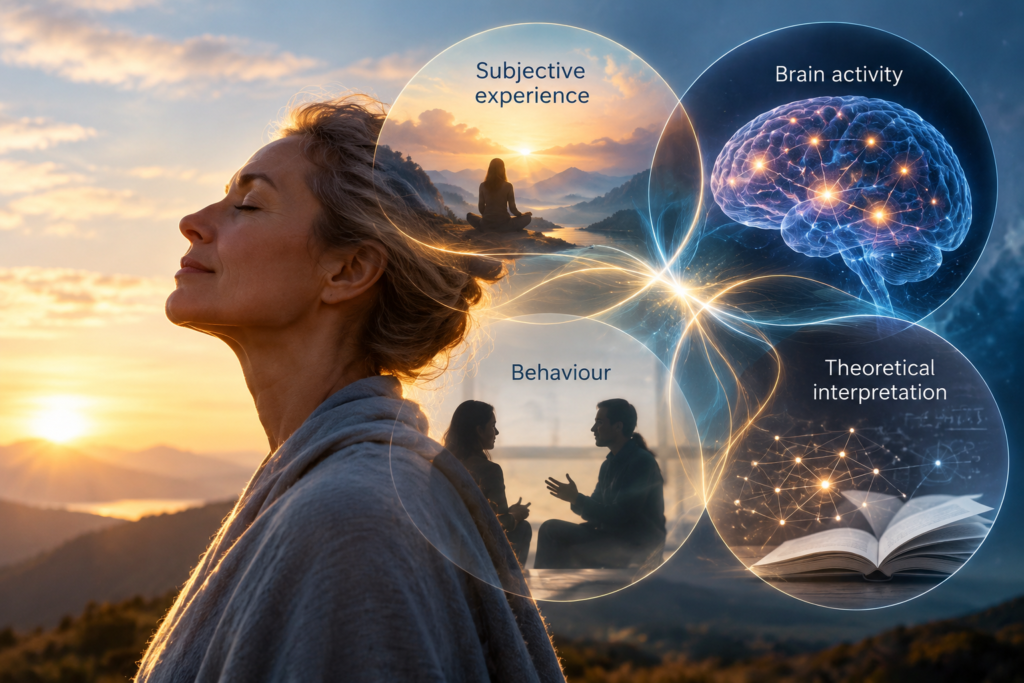
How Can We Know Consciousness?
Before asking what consciousness is, we need to ask how we can know it.
Consciousness requires us to bring together different forms of evidence: subjective experience, behaviour, brain activity, and theoretical interpretation. None is sufficient on its own.
For transpersonal research, this means taking experiences such as meditation, hypnosis, and mystical states seriously, while avoiding the assumption that an intense experience automatically proves its interpretation.
Understanding consciousness may therefore depend less on choosing one theory than on learning how different ways of knowing can inform and challenge one another.
Other Publications on My Research in Psychology
In addition to the research and essays available on this site, several of my contributions have been published on internationally recognized platforms and journals.
- On Mindstream Connect, I shared an essay on the quest for meaning and the redefinition of our life purpose: It’s never too late to redefine our own life purpose.
- In the Alef Trust Journal, I published an academic article exploring the connections between transpersonal psychology, consciousness, and personal transformation: Alef Trust Journal Article.
- In the professional magazine HR Today, I contributed to the reflection on management styles with an article entitled: Existe-t-il un leadership féminin ?
These publications reflect my commitment to nurturing dialogue between academic research, professional practice, and societal questions, by offering varied and complementary perspectives.