
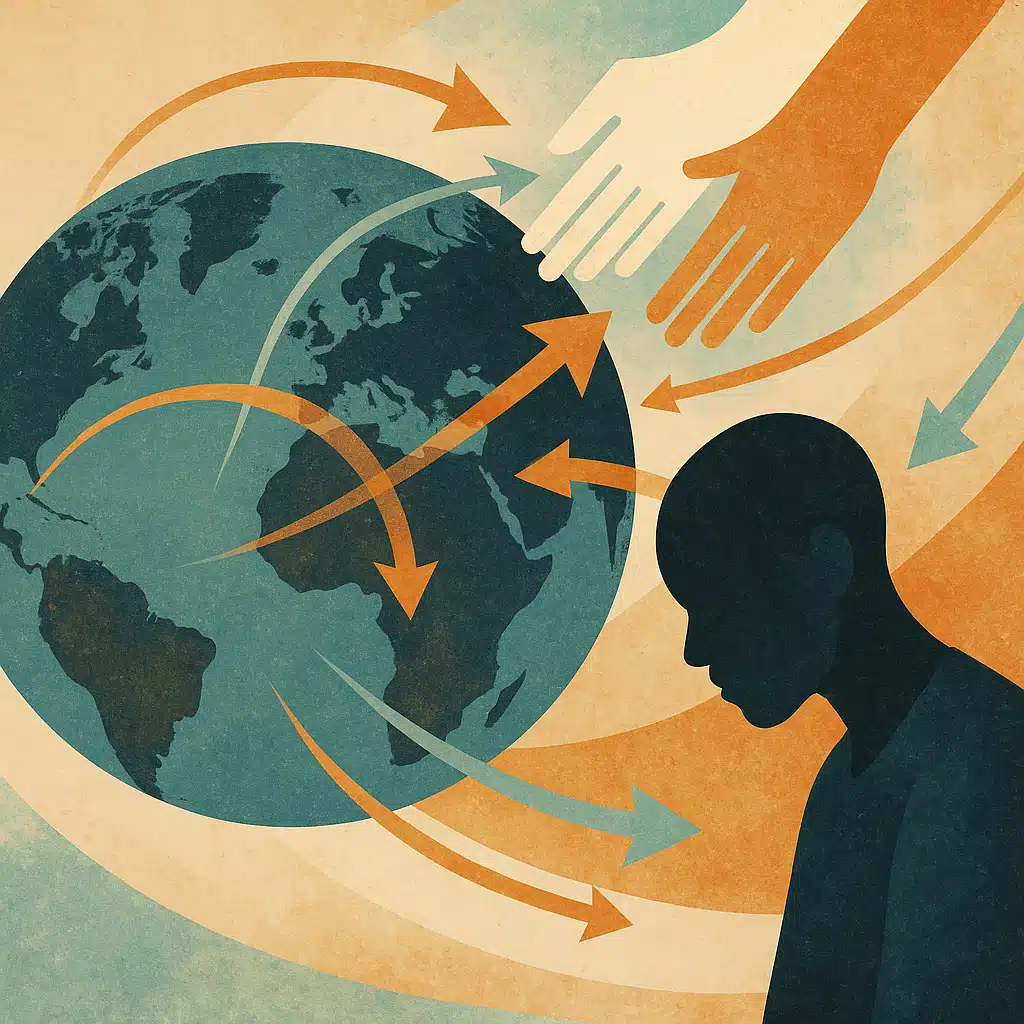
More than sixty years after the first major development aid programs were launched, sub-Saharan Africa remains one of the most vulnerable regions in the world. Despite unprecedented financial flows and the involvement of a vast constellation of international actors, poverty is rising in absolute numbers, inequalities are deepening, and crises — climatic, political, and economic — are unfolding faster than the development system can respond.
In this changing landscape, one question has become unavoidable: does development aid still work?
A System That Has Become Unmanageably Fragmented
The ecosystem of development aid has expanded far beyond its original architecture. Traditional donors such as the World Bank, the IMF, the European Union and bilateral aid agencies remain influential, but they now share the field with an array of new players: Gulf sovereign wealth funds, Chinese development banks, Indian and Turkish cooperation agencies, philanthropic foundations, private consulting firms, and technology-driven initiatives. NGOs — from major international organizations to hyper-local community groups — operate within this increasingly crowded space.
What might have generated dynamism and innovation has instead produced extreme fragmentation. Each actor advances its own priorities, shaped by national strategies, security agendas, economic interests, or ideological frameworks. In several African countries, ministries of cooperation report more than 200 external partners active simultaneously, with no mechanism capable of orchestrating their interventions.
Duplication of efforts, contradictory objectives and incompatible reporting systems have become structural features of the aid industry. Coordination is no longer an aspiration ignored by lack of resources; it is now an absence that shapes the entire system.
Aid as a Geopolitical Instrument
For decades, development assistance was framed as a North–South relationship built on solidarity and postcolonial responsibility. That model no longer reflects the realities of 2025.
A different axis has emerged. China finances large-scale infrastructure — railways, ports, dams — in exchange for access to natural resources. India is expanding its footprint in digital health and education. The Gulf states invest strategically in agriculture, transportation and energy. Turkey is multiplying construction projects and strengthening religious networks.
In many countries, these actors have eclipsed traditional European donors. Chinese investments in Kenya now exceed European financial commitments. In the Democratic Republic of Congo, mining-for-infrastructure deals weigh more heavily on the national economy than decades of Western development aid combined.
Aid has thus shifted from a tool of solidarity to a key instrument in global competition, redefining influence on a continent pivotal to the future of commodities, security and global demographics.
Poverty Rising Despite Expanding Financial Flows
Judged by its outcomes, development aid presents a striking contradiction. Never before have so many resources been mobilized for Africa, yet social indicators stagnate or decline.
More than 430 million Africans currently live in extreme poverty. The gains made in the early 2000s were erased by the pandemic, rising food prices, climatic shocks and political instability.
In the Sahel, the closure of schools, the deterioration of health systems and mass displacement have reversed two decades of development progress. Even in fast-growing economies like Côte d’Ivoire, Senegal or Ethiopia (before the civil war), inequalities have widened.
Another well-documented phenomenon has intensified: the capture of aid by political elites. In resource-rich countries, opaque negotiations between governments and external partners often turn development funding into a source of political consolidation rather than social transformation.
The paradox is now undeniable: the more the system expands, the more its impact becomes diluted.
Three Forces Reshaping Africa’s Trajectory
Climate change, technological innovation and security crises form the triad that now defines the continent’s development pathway.
Climate change poses the most severe long-term threat. Droughts in the Horn of Africa, devastating floods in Nigeria, coastal erosion in West Africa and declining agricultural yields across the Sahel are turning humanitarian responses into permanent fixtures. The UN estimates that up to 85 million Africans could be displaced internally by 2050 due to environmental pressures.
The digital revolution, by contrast, is one of the region’s few accelerators of positive change. Mobile money systems, agricultural platforms, digital health tools and online governance mechanisms are reshaping service delivery. In some cases, they bypass corruption and dysfunction altogether, offering communities access to services that governments have failed to provide.
Yet the security crisis — especially in the Sahel — remains the most immediate barrier to sustainable development. The collapse of state authority in Mali, Burkina Faso and Niger, combined with the retreat of traditional partners and the presence of external military actors, has exposed an uncomfortable truth: there can be no development without political stability.
Toward a New Global Development Contract
The classical model of development aid is struggling to keep pace with the profound transformations underway. Coordination mechanisms remain weak, national interests dominate multilateral agendas, and local populations rarely participate in decision-making processes that directly affect them.
Still, there are signs of real potential.
African regional institutions are gaining influence. The African Union is asserting itself diplomatically. Local civil society movements are demanding accountability. Tech innovators are designing African solutions to African problems. The architecture of global governance is slowly — very slowly — becoming more inclusive.
For aid to remain relevant, it must clarify its purpose, acknowledge the political nature of development, and confront the tension between solidarity and geopolitical competition rather than masking it behind technocratic language. It must also shift power toward local actors and build long-term resilience rather than short-term visibility.
The world is being reconfigured before our eyes. For development aid to become effective again, it must be reimagined — not as a relic of the postwar order, but as a shared global responsibility rooted in transparency, coherence and genuine partnership.
Sub-Saharan Africa does not need more actors. It needs a system capable of aligning them.
If you would like to discuss development strategy, leadership transitions, or international cooperation, you can contact me directly.
I also explore these themes in depth on my channel Awakening the Spiritual Mind.
👉 Contact me here
👉 Listen to the podcast
Additional Resources
Aid effectiveness and donor motives — A. Dreher et al., 2024. Cette étude montre que l’aide extérieure favorise rarement la croissance, et que les motivations des bailleurs (géopolitiques, stratégiques, etc.) modulent fortement son efficacité. ScienceDirect
↳ https://www.sciencedirect.com/science/article/pii/S0305750X23003194Corruption, political instability, climate change and economic growth in Sub‑Saharan Africa — D.D. Chamma et al., 2025. Ce travail analyse comment la corruption, l’instabilité politique et le changement climatique se combinent pour freiner la croissance économique en Afrique subsaharienne. Tandfonline
↳ https://www.tandfonline.com/doi/full/10.1080/23322039.2025.2570791Climate Finance, Institutions & Innovation Systems in Sub‑Saharan Africa — PSE Journal, 2025. L’article explore l’interaction entre financement climatique, qualité des institutions et innovation dans les pays africains : un angle essentiel pour repenser l’aide dans le contexte du changement climatique. Public Sector Economics
↳ [lien du journal / article]Cuts in Official Development Assistance – Projections 2025‑2027 — OECD, 2025. Ce rapport met en lumière les récentes réductions de l’APD par les grands bailleurs (États européens, États-Unis), et le risque accru pour les pays les plus pauvres, y compris en Afrique subsaharienne. OECD+1
↳ https://doi.org/10.1787/811056e3-frWill Foreign Aid Foster Economic Development? Empirical Evidence from China’s Aid to Africa — Churen Sun, Jinqiang Xu & Hui Jiang, 2024. Cette étude récente interroge l’impact de l’aide chinoise sur le développement en Afrique : infrastructure, industrialisation, chaînes de valeur — mais elle observe des effets très variables selon les contextes. ResearchGate
↳ via ResearchGate / J Int Dev (2024)