
Beyond the social explanations of violence
We usually explain violence through economic, cultural, or political factors. Inequality, education, collective trauma, identity tensions: these are valuable lenses for making sense of the conflicts that run through human societies. Yet they tend to leave a more fundamental question in shadow. Why does violence remain a constant of human experience, across every era, every political system, every level of material wealth?
This is precisely the question existential psychology raises. As early as 1950, the psychologist Werner Wolff advanced a bold hypothesis: collective crises are the reflection of deeper crises born within the human personality. The crisis of our time, he argued in substance, mirrors the crisis of our personality. Social tensions cannot be understood apart from the inner conflicts that divide individuals. Violence is not merely a reaction to a hostile environment; it is also the outward expression of an inner division.
This perspective does not deny the weight of social context. It asks us to think the dynamic relationship between the inner and the outer world. Societies are made of human beings whose fears, frustrations, desires for domination, and wounds shape institutions, ideologies, and collective behavior.
Violence as a rupture with oneself
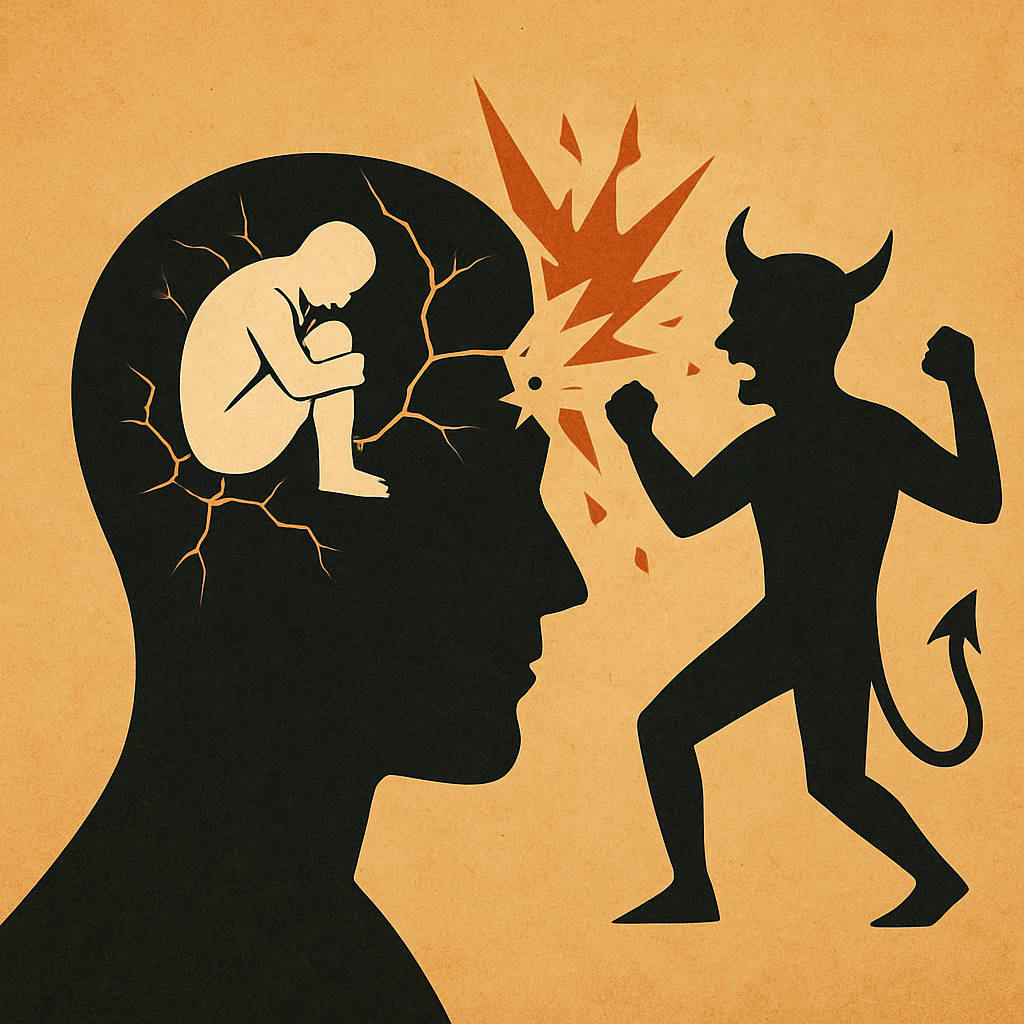
The most fertile intuition of existential psychology can be stated simply: violence is first directed against oneself.
For Wolff, outer conflict takes root in a form of inner exclusion. The individual becomes severed from a part of himself, from his deeper values, from his existential orientation. That rupture generates a psychic tension that seeks an outlet. When it cannot be worked through consciously, it is projected outward as hostility, aggression, the search for scapegoats.
Here the work of Carl Gustav Jung lends a depth that Wolff alone does not reach. For Jung, the personality contains an unconscious dimension he calls the Shadow: everything we refuse to acknowledge in ourselves — aggressive impulses, desires for power, jealousy, fear, feelings of inferiority.
The more the Shadow remains unconscious, the more it is projected onto others. What we reject in ourselves reappears in the other, amplified and threatening. A significant part of human violence can thus be understood as the inability to recognize one\’s own dark side. The external enemy becomes the psychological carrier of an unresolved inner conflict.
This reading illuminates both individual conflict and collective phenomena. Periods of polarization almost always involve the designation of groups held responsible for a general malaise. Behind that mechanism lies a collective difficulty: acknowledging the contradictions, fears, and fragilities present within the community itself.
Exclusion: a silent violence
Violence does not only wear the face of aggression or destruction. Some of its deepest forms take the face of indifference.
In several of the world\’s most prosperous cities, the daily sight of people living or dying on the street sits beside the steady flow of luxury vehicles and the concentration of vast wealth. This coexistence does not merely speak of economic inequality. It reveals a psychological phenomenon of invisibilization: the other ceases to appear as a subject in our gaze.
This is what makes exclusion a violence in its own right: it strips the individual of symbolic recognition. To be excluded is to no longer be seen. The suffering lies not only in material lack but in the gradual disappearance of any inscription within the human community.
The philosopher Axel Honneth\’s work on recognition shows that identity is built through relations of mutual regard. When that recognition disappears, it is the very sense of existing that is undermined. Social exclusion is therefore an ontological violence: it strikes the being in its fundamental need for belonging and meaning.
The necessary outcast: why exclusion is wanted
So far we have treated exclusion as a failure — something the social machine produces by accident and would correct if it could see clearly. But there is a harder possibility, and it is the one that actually fits what we observe. The outcast is not a malfunction of the system. He is one of its load-bearing parts.
Consider what the figure on the sidewalk does for the one who passes by in comfort. He is a danger, a measure, and a goad all at once. A danger, because he embodies the fear of falling — of becoming dependent, worthless, stripped of everything one owns. A measure, because one cannot feel the weight of one\’s own success except by comparison with someone who has nothing. A goad, because his visible fate is a permanent warning to keep climbing. This is not a contradiction the system tolerates; it is a function it requires.
This is, almost feature for feature, what René Girard called the scapegoat mechanism: a collective tension discharges onto a figure whose exclusion founds the cohesion of the group. With one difference. Here the mechanism has economized itself. The outcast is not the object of a ritual killing; he is kept alive and visible, on the street, because his permanent presence is more useful than his disappearance. He must remain there to serve as a measure.
The \”danger\” we believe we see in him is the inverted form of an inner fear — the fear of my own fall, my own dependency, my own lack of worth outside of what I possess. The outcast carries my disowned fragility. The threat I think I see in him is in me. This is, precisely, Jung\’s definition of projection.
California pushes this arrangement to its limit because it inherits, in secularized form, the Calvinist matrix Max Weber described: material success as a sign of election, poverty as a sign of reprobation. The outcast is not merely tolerated; he is necessary to the moral legibility of the myth. He proves the system is just — he must have deserved it — and he warns of what awaits anyone who weakens. To make this conscious, here, is to touch the founding myth of merit itself. Hence the resistance.
But — and this is the opening — the necessity is real and relative. The outcast is necessary to a self that can only measure itself by comparison. He is not necessary to the human being as such. The entire transformation lives in that gap.
So how does one make this collective Shadow conscious? Not head-on, and not collectively first. The opening move is to name the function — to admit that exclusion performs a kind of work. The scapegoat mechanism holds only as long as it stays invisible; seeing it already weakens it. The second move is to withdraw the projection: to stop housing my own precariousness in the other. The third is the most demanding, and it is the same point we reach everywhere in this essay: as long as my worth is purely comparative, I depend on the existence of people poorer than I am. One does not free the outcast through compassion; one frees him by displacing the source of worth — from comparison toward orientation. A self that draws its meaning from something other than rank no longer needs a human yardstick.
And this consciousness is never abstract. It is not born from the category \”the poor\” but from the singular encounter — the face, as Levinas would say, that looks at me and interrupts the calculation. The collective Shadow does not dissolve en masse. It dissolves one face at a time.
Philanthropy and possession by the collective Shadow
Contemporary societies are also marked by the remarkable growth of the charitable and philanthropic sector. Foundations, charities, and social programs now mobilize immense resources.
This movement reflects genuine altruistic commitment. But it also reveals a paradox. The continual rise in social need is matched by a parallel rise in the apparatus of repair, as if the same structures simultaneously produced the fractures and the means to soften them.
One could read this as cynical calculation. That would be a mistake. The Jungian reading offers a more accurate — and more disturbing — explanation: possession by the collective Shadow. When a dimension of the collective psyche is denied or repressed, it does not vanish; it works in silence and calls forth compensatory mechanisms. Philanthropic compensation then functions as the neurotic symptom functions for the individual: it relieves the tension without questioning its cause. The gift repairs the consequence and, in the same gesture, excuses one from examining the logics that produce exclusion.
The most contemporary violence is therefore no longer spectacular. It takes the form of a gradual normalization of indifference — a collective Shadow so well integrated into the landscape that it is no longer seen.
Loneliness and the loss of meaning
Another phenomenon runs insistently through contemporary research: the rise of loneliness and the loss of meaning in modern societies.
Viktor Frankl, Rollo May, and Irvin Yalom converge on one finding: the human being bears the absence of meaning poorly. When the great collective narratives weaken and traditional belonging loses its structuring force, freedom is often experienced as a void.
But their agreement stops there — and it is their disagreement that best illuminates the question of violence. For Frankl, meaning exists; it is to be discovered, even at the heart of suffering, and it is the \”will to meaning\” that sustains existence. For Yalom, the universe offers no given meaning: faced with death, freedom, and isolation, the human being must create his own out of the void itself. May holds an intermediate position: the anxiety before that void is not an illness to be removed but the energy — the daimonic — that, once owned, becomes creative power.
This tension is not a flaw in existential thought; it maps its real terrain. To find, or to create. It is precisely between these two poles that the fate of the disoriented individual is decided. And when neither occurs — when meaning is neither received nor invented — the void seeks to fill itself otherwise: through violence against oneself, against others, or through the symbolic violence of exclusion and indifference.
Material abundance does not answer this question. A society can reach remarkable technological development and produce a profound disorientation: one of the major paradoxes of modernity.
From the destructive to the creative personality
There remains the hardest question, the one theory too often passes over too quickly. How does the energy bound up in inner conflict reconvert? How does one move from rupture to integration?
The resolution of violence does not rest on behavioral control alone. Repressing aggression only displaces the tension. What transforms is a deeper movement, the one Jung calls individuation: the gradual integration of the various dimensions of the psyche, beginning with the Shadow.
And this movement has a precise logic. As long as the rejected part stays unconscious, psychic energy is spent maintaining the division — not seeing, projecting outward. The first step is therefore not an act of will but a recognition: to stop lodging in the other what belongs to me. Once the rupture is made conscious, the energy once used to repress it is freed and becomes available again.
This is where symbolic work proves decisive. The image, the dream, the narrative, the imaginal form offer a bridge between what has been acted out — against oneself or against others — and what can at last be felt, named, and rejoined. To return to the original rupture not in order to relive it but in order to symbolize it: this is the moment when what kept repeating blindly no longer needs to replay itself. Accompaniment, in its various forms, has no other function than to hold this space where tension can be transformed rather than discharged.
Creativity then takes on its full meaning — not art in the narrow sense, but the capacity to take conscious part in the construction of one\’s own existence. The true alternative to violence is not the absence of aggression. It is the possibility, for a human being, of recovering an inner orientation, of reconciling the components of his personality, and of rediscovering a meaning wide enough to outgrow the retreat into the self.
The question of violence thus leads to a more fundamental one: the quality of the bond a human being keeps with himself, with others, and with the meaning he gives to his existence.
The hardest movements this essay describes — withdrawing a projection, reconciling what has been divided within, finding an orientation that no longer depends on comparison — are seldom made alone. I accompany individuals through transitions and the complex inner passages that come with them. If these questions are alive for you right now, I\’d welcome a conversation.
References
Frankl, V. E. (1963). Man\’s Search for Meaning. Beacon Press.
Girard, R. (1986). The Scapegoat. Johns Hopkins University Press.
Honneth, A. (1995). The Struggle for Recognition. MIT Press.
Jung, C. G. (1957). The Undiscovered Self. Princeton University Press.
Jung, C. G. (1959). Aion: Researches into the Phenomenology of the Self. Princeton University Press.
Levinas, E. (1969). Totality and Infinity. Duquesne University Press.
May, R. (1981). Freedom and Destiny. W. W. Norton.
Weber, M. (1930). The Protestant Ethic and the Spirit of Capitalism. Routledge.
Wolff, W. (1950). Values and Personality: An Existential Psychology of Crisis. Grune & Stratton.