
Change is no longer the exception—it is the rule. Non-profits today face a world defined by volatility: social crises, climate emergencies, shifting donor priorities, and increasing demands for accountability. Traditional project management frameworks—focused on rigid planning and control—often fail to capture the complexity of these realities.
The Change-Oriented Approach (COA), first developed by the French network F3E, offers a new path. It recognizes that meaningful change is non-linear, deeply human, and rooted in values. Instead of asking, “How do we control change?”, COA asks: “How do we learn and evolve through it?”
Why COA Matters for Non-Profits Today
Non-profit organizations are under unprecedented pressure. They must demonstrate results to donors, adapt quickly to crises, and maintain credibility among communities and partners—all while remaining faithful to their mission.
The COA helps address these challenges by:
Reconnecting purpose with practice – ensuring that projects respond to authentic societal needs rather than being driven solely by donor requirements.
Strengthening legitimacy and trust – by involving stakeholders, including communities, in co-creating the pathways of change.
Turning monitoring into learning – transforming evaluation from a compliance exercise into a driver of capacity-building and continuous adaptation.
Embracing uncertainty – enabling organizations to stay agile in unpredictable contexts.
Building identity and resilience – by acknowledging that an organization’s culture, history, and people are strategic assets, not side issues.
In short, COA equips non-profits to move from survival mode to transformative impact.
A Living, Human-Centered Approach
Unlike top-down models that reduce change to a chain of inputs and outputs, the COA focuses on the actors of change—the people, organizations, and communities engaged in the process. It integrates complexity, subjectivity, and values into every stage of transformation.
Key principles include:
Purpose before performance: always ask why before asking what.
Iteration before rigidity: design short cycles of action and reflection, not long inflexible plans.
Collective intelligence before hierarchy: recognize that identity, culture, and group dynamics shape impact as much as funding and resources.
This resonates with the philosophy of learning organizations (Peter Senge, The Fifth Discipline), which view organizations as living systems that must constantly adapt and evolve.
The Four Steps of the Change-Oriented Approach
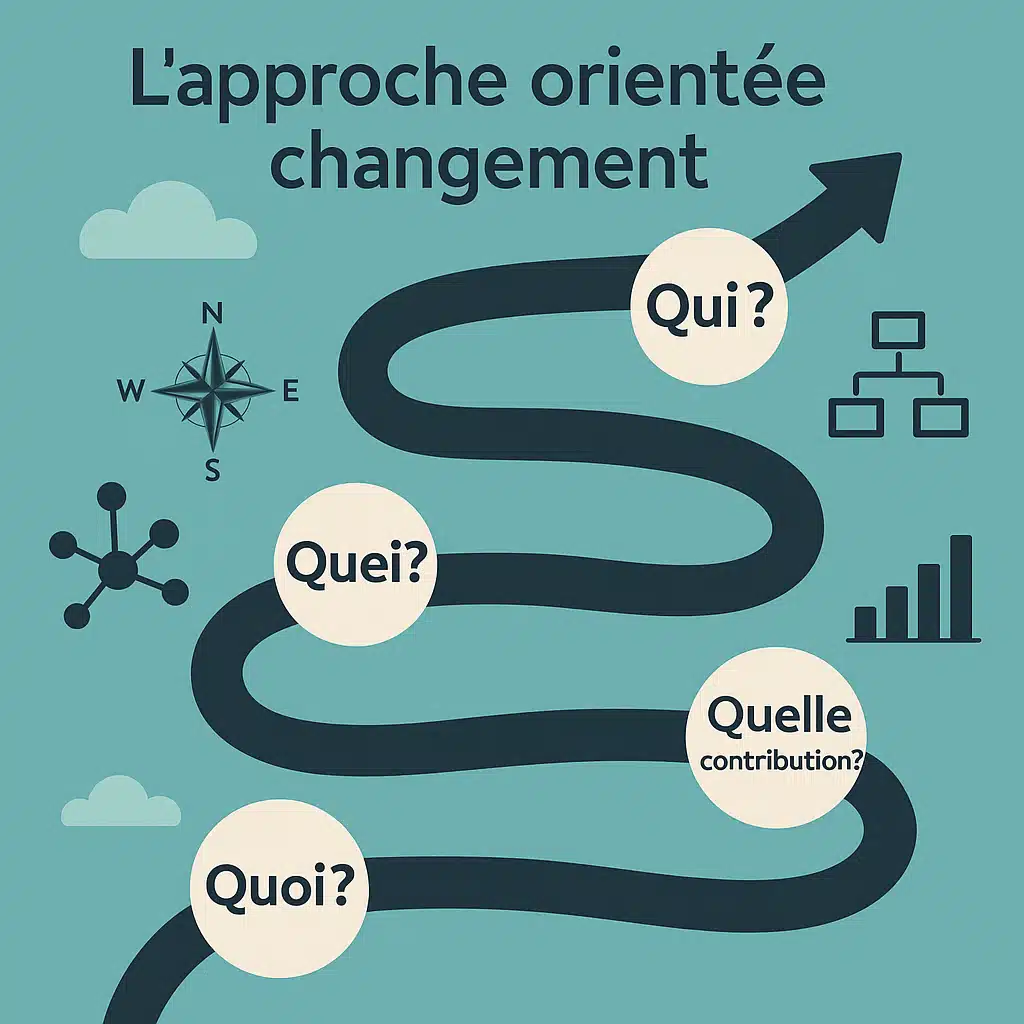
The methodology is often applied through a participatory workshop called “Pathways of Change”. It unfolds in four iterative stages:
What?
Define the vision of change. Start not with problems, but with an ideal: Which societal needs do we want to address? What would our organizational epitaph say?Who?
Map the actors. Identify stakeholders—supporters, opponents, partners, and symbolic figures—who shape the change ecosystem.How?
Develop a theory of change. Clarify the processes, values, and intermediate steps without reducing them to simplistic cause-and-effect chains.What contribution?
Define the organization’s role. Plan short-term actions while embracing uncertainty. Here, monitoring and evaluation become tools for collective learning, not external control.
Beyond Tools: A Question of Identity
At its core, COA is not just a methodology—it is a shift in identity and perspective. It invites organizations to ask:
Who are we, beyond our projects?
What is our unique role in the evolution of society?
How do our culture, history, and people shape the way we act?
This self-reflection builds authenticity and strengthens the connection between values, vision, and impact.
The Five Essentials of COA
A shared vision of change, grounded in a fine-grained analysis of context.
An evolving and adaptive process focused on learning.
An action hypothesis rooted in explicit values.
Strategies open to uncertainty and adjustment.
A permanent dialogue between intention, process, and lived reality.
Conclusion
The Change-Oriented Approach does not offer a quick fix. Instead, it fosters vigilance, humility, and collective intelligence. By reconnecting purpose, values, and process, it allows non-profits to engage in transformation that is both realistic and inspiring.
For leaders navigating today’s uncertainties, COA is more than a methodology—it is a mindset. One that places humanity, learning, and shared meaning at the heart of change.
You are managing a change, contact me
References & Further Reading
F3E – Change-Oriented Approaches
Change-oriented approaches. Facilitating a workshop on vision and pathways to change (Action Education / F3E).
👉 Read here
Plan International & AMI – Monitoring & Evaluation
Development and Implementation of a Change-Oriented Monitoring & Evaluation System (M&E) (2025).
👉 Read here
Equipop / F3E – Making Changes Visible
Making changes visible: A critical methodological issue for development practitioners.
👉 Read here
F3E – Evaluation Benchmark (2014)
International Evaluation Benchmark: Guidelines for change-oriented evaluation.
👉 Read here
Peter M. Senge (1990 / 2006)
The Fifth Discipline: The Art & Practice of the Learning Organization. Doubleday.
👉 Amazon link
Toolshero – Learning Organizations
Senge’s Five Disciplines of Learning Organizations.
👉 Read here