
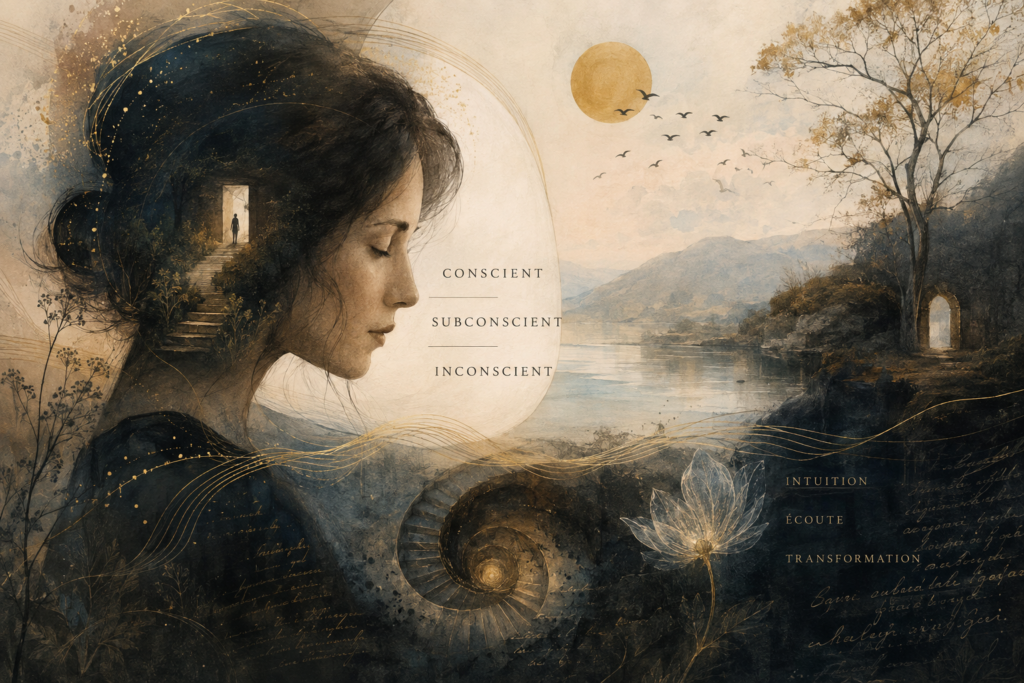
Consciousness is one of those words that seems immediately understandable until we try to define it. We know what it means to be awake rather than asleep, to be aware of what we are seeing or feeling, to notice our own thoughts and to recognize ourselves as the subject of an experience. Yet, as soon as we ask what consciousness actually is, the apparent simplicity disappears.
Psychology, neuroscience, philosophy and contemplative traditions have each approached the question from different perspectives, but none has produced a definition that commands universal agreement. Contemporary consciousness research itself remains divided among several major theoretical approaches, including Global Neuronal Workspace Theory, Higher-Order theories, Recurrent Processing theories and Integrated Information Theory. These theories do not simply offer different explanations of the same phenomenon; they sometimes disagree about what should count as the phenomenon to be explained in the first place. (Nature)
This lack of consensus is not necessarily a weakness. It may instead tell us something important about consciousness: perhaps what we call consciousness is not a single phenomenon but a complex field of processes that can be approached at several levels.
Consciousness is not a single, uniform state
One useful distinction in contemporary research is between consciousness as a capacity or phenomenon and states of consciousness. The latter refer to different configurations of experience and brain activity: ordinary waking consciousness, sleep, dreaming, meditation and other altered or unusual states. Experimental research has demonstrated that these states can differ substantially in perception, attention, memory, emotion and the organization of thought. (Springer Nature)
This already complicates the idea that we move simply between being conscious and unconscious. During sleep, for example, consciousness does not disappear in an absolute sense. Dreaming demonstrates that highly organized subjective experience can occur in a state radically different from ordinary waking awareness. Lucid dreaming, hypnagogic states, meditation and hypnosis further illustrate that consciousness can be modified without necessarily being lost. (PubMed Central (PMC))
The question therefore becomes less binary. Instead of asking whether we are conscious or unconscious, it may be more fruitful to ask what kind of awareness is operating, what information is accessible to it, and how that information is being organized at a particular moment.
This perspective is important because it prevents us from treating consciousness as though it were a light that is either switched on or switched off. Human experience appears to be considerably more continuous, layered and dynamic.
Conscious, unconscious and the question of what lies beneath awareness
Psychology has long recognized that a considerable part of mental activity occurs outside conscious awareness. Contemporary neuroscience provides abundant evidence that the brain continuously processes information without that processing becoming available to conscious report. The Global Neuronal Workspace model, for example, proposes that information becomes consciously accessible when it is amplified and made globally available across distributed brain systems. Much of the processing preceding this conscious access remains outside awareness. (PubMed Central (PMC))
The distinction between conscious and unconscious processes, however, should not be confused with the older idea of the unconscious as simply a hidden storage room containing everything we have forgotten. The unconscious can influence perception, emotion, decision-making and behavior without necessarily becoming an explicit thought.
It is in this context that I find the word subconscious useful, although I use it in a somewhat broader and more experiential sense than contemporary neuroscience generally does.
For me, the subconscious can be understood as a reservoir of psychic material: aspects of ourselves that are not immediately accessible to ordinary awareness but nevertheless participate in the way we experience and interpret our lives. Some of this material may originate in our individual history — memories, emotional patterns, implicit learning, unresolved experiences and aspects of our personality that have never been fully brought into conscious understanding.
But this is not necessarily where the exploration ends.
From the personal unconscious to the collective dimension
Carl Gustav Jung introduced a distinction that remains particularly relevant to anyone interested in the deeper layers of the psyche. He differentiated the personal unconscious, whose contents are related to the individual’s experience, from what he called the collective unconscious.
For Jung, the collective unconscious was not simply a repository of memories shared by humanity. It referred to a deeper structural dimension of the psyche, expressed through recurring archetypal patterns. His argument emerged from his observation of recurring symbolic motifs in dreams, mythology, religion and cultural traditions. (Jung Page)
This is a very different proposition from saying that every person has access to a literal storehouse of universal information. Jung’s theory belongs to a particular psychological tradition, and its claims should not be confused with experimentally established models of brain function. Yet it offers a provocative way of thinking about an experience familiar to many people: sometimes an image, dream, metaphor or intuition seems to carry a meaning that is larger than the conscious circumstances that gave rise to it.
Jung’s contribution is therefore less interesting if understood as a claim that has simply been proven or disproven than if we consider it as an attempt to describe something difficult to capture through ordinary psychological categories: the possibility that the psyche organizes experience through symbolic patterns that precede our conscious interpretation of them.
This is also where the distinction between information and meaning becomes important.
Is intuition a form of access?
In my own practice, I have come to regard intuition as a possible doorway into this less immediately accessible dimension of experience.
This does not mean that intuition should automatically be considered a source of objective knowledge. Psychological research has shown that intuitive judgments can sometimes reflect rapid and sophisticated pattern recognition, while in other circumstances they can be distorted by cognitive biases, expectations or emotional states. Intuition therefore deserves neither blind trust nor automatic dismissal.
Its value may lie elsewhere.
An intuitive perception can sometimes bring something into awareness before we are able to explain why it matters. A word suddenly stands out. An image appears. A metaphor seems strangely precise. A connection emerges between apparently unrelated elements. The conscious mind may not yet know what to make of it, but something has already begun to organize itself.
This is why I place such importance on listening.
Intuition, in this sense, is not necessarily the opposite of reason. It may be what allows something that has not yet been formulated rationally to become available for conscious reflection.
What hypnosis reveals about the layers of the psyche
This distinction has particular significance in my work with hypnosis.
Before a hypnosis session, I listen carefully to the person’s language. Not only to the story being told, but also to the words chosen, the images that recur, the metaphors that spontaneously appear, the contradictions between what is said and what seems to be experienced, and sometimes to what remains unsaid.
The purpose is not to impose an interpretation on the person. Rather, these elements can provide clues about the symbolic language through which that person’s inner experience is organized.
From this perspective, creating a hypnosis script becomes less a matter of applying a predetermined technique than of entering into a dialogue with the person’s own symbolic world. A metaphor may become the starting point for another metaphor; an image may open onto an emotional memory; a recurring expression may reveal a tension that had not previously been formulated consciously.
The process continues during the hypnosis session itself. I listen again, this time to what emerges from the person’s experience. What appears may be an image, a sensation, a memory, a shift in perspective or something much more difficult to describe.
This is one reason I am cautious about reducing hypnosis to the idea of simply accessing the “subconscious.” The word can suggest that there is a clearly defined inner chamber containing predetermined answers, waiting to be unlocked.
My experience is more dynamic than that.
The unconscious does not necessarily contain ready-made solutions. It may contain possibilities for reorganization.
From accessing the unconscious to transforming the psyche
This leads to what I consider the most interesting aspect of the process.
When material that was previously outside conscious awareness becomes available, the objective is not necessarily to bring everything into consciousness. Consciousness itself has limits. Nor is greater awareness automatically synonymous with psychological health.
What matters may be the relationship established between what is conscious and what is not.
Jung’s concept of individuation offers one way of understanding this process. In his analytical psychology, psychological development involves an increasingly differentiated relationship between conscious identity and the unconscious dimensions of the psyche. Dreams, symbols and other unconscious productions can participate in this process by bringing material into a form that consciousness can encounter and reflect upon. (Jung Page)
I experience something analogous in hypnosis, although I would not equate hypnosis with Jungian analysis.
The movement is not simply from unconscious to conscious. It is a movement between levels of experience. Something emerges from beneath ordinary awareness; consciousness encounters it; meaning is reorganized; and the new understanding can, in turn, alter the person’s relationship with what originally seemed fixed.
This is why I sometimes think of the process as a form of psychological transmutation.
The metaphor of alchemy is useful here, not because hypnosis literally transforms one substance into another, but because alchemical language captures something that purely cognitive language can sometimes miss: the transformation of psychic material rather than merely its intellectual interpretation.
And what about the Akashic field?
At this point, my own understanding moves beyond what contemporary psychology and neuroscience can currently establish.
Some authors, including Ervin Laszlo, have proposed models in which consciousness is connected to a broader informational field, sometimes described in terms of an Akashic field. This idea resonates with certain spiritual and transpersonal traditions and with the intuition that consciousness may not be completely reducible to individual psychological history.
However, this proposition belongs to a speculative and philosophical domain rather than to an established scientific model of consciousness. It is therefore important to preserve the distinction between a meaningful metaphysical hypothesis and an empirically demonstrated phenomenon.
I find the question nevertheless worth keeping open.
Science has not yet resolved the fundamental problem of consciousness. Even among contemporary neuroscientific theories, there is substantial disagreement about how conscious experience arises and how it should be characterized. (Nature)
Perhaps the most intellectually honest position is therefore neither to dismiss every transpersonal hypothesis as meaningless nor to present it prematurely as scientific fact.
There is value in allowing a question to remain a question.
Consciousness as a relationship rather than a hierarchy
This brings me back to the title of this article: what are the different types of consciousness?
Perhaps the answer is not a hierarchy of increasingly elevated states, with ordinary consciousness at the bottom and some supposedly superior state at the top.
A more subtle possibility is that consciousness is a relationship between different modes of experiencing and knowing.
There is the ordinary consciousness through which we navigate the external world. There are unconscious processes that continuously influence perception and behavior. There are dreams and symbolic experiences that reorganize material in ways that do not follow ordinary rational logic. There are altered states in which perception, attention and the sense of self can change. There are also forms of metacognitive awareness in which consciousness becomes capable, to some degree, of observing its own processes.
Contemporary research increasingly recognizes that consciousness cannot be adequately described through a single dimension. Different theories emphasize global access, integration, recurrent processing, metacognition or predictive organization, and the debate between them remains active. (Nature)
The practical implication is subtle but significant: becoming more conscious may not mean simply becoming more aware of more things.
It may mean becoming capable of relating differently to what appears in awareness — including what emerges from beyond our ordinary sense of ourselves.
Listening at the threshold
This is ultimately why listening has become so central to my practice.
Listening is not passive. To listen deeply is to suspend, at least temporarily, the impulse to classify what is heard according to what we already believe. It creates a space in which something not yet fully formulated can begin to take shape.
In hypnosis, this listening occurs between two people, but it also occurs within the person: between what is consciously known and what is beginning to emerge; between language and image; between memory and meaning; between the familiar identity and possibilities that have not yet found a place within it.
Perhaps this is one of the more useful ways to think about the so-called subconscious. Rather than imagining it as a hidden room beneath consciousness, we might imagine it as a threshold — a continuously moving boundary between what we can currently know about ourselves and what has not yet become conscious.
The deeper question, then, is not simply how many types of consciousness exist.
It is what becomes possible when we learn to listen at the threshold between them.
Continue the exploration
What becomes possible when we begin to pay attention not only to what we consciously think, but also to the images, intuitions, sensations and associations that arise at the edges of awareness?
The Awakening Journal was created as a space for this kind of exploration. It offers a series of reflections and practices designed to help you observe your inner experience, recognize patterns and explore the relationship between conscious awareness and the less visible dimensions of the psyche.
You can download the free Awakening Journal and continue the exploration at your own pace.
References
Chalmers, D. J. (1995). Facing up to the problem of consciousness. Journal of Consciousness Studies, 2(3), 200–219. Outbound — Journal of Consciousness Studies
Jung, C. G. (1969). The archetypes and the collective unconscious (2nd ed., R. F. C. Hull, Trans.). Princeton University Press. (Original work published 1959). Outbound — Princeton University Press
Le texte de Jung sur le concept d’inconscient collectif est également disponible en ligne.
Knafo, G., & Weinberger, J. (2024). Exploring the role of conscious and unconscious processes in hypnosis: A theoretical review. Brain Sciences, 14(4), 374. https://doi.org/10.3390/brainsci14040374
Laszlo, E. (2004). Science and the Akashic field: An integral theory of everything. Inner Traditions.
Mazzoni, G., Venneri, A., McGeown, W. J., & Kirsch, I. (2013). Neuroimaging resolution of the altered state hypothesis. Cortex, 49(2), 400–410. https://doi.org/10.1016/j.cortex.2012.08.005
Seth, A. K., & Bayne, T. (2022). Theories of consciousness. Nature Reviews Neuroscience, 23, 439–452. https://doi.org/10.1038/s41583-022-00587-4
Terhune, D. B., Cleeremans, A., Raz, A., & Lynn, S. J. (2017). Hypnosis and top-down regulation of consciousness. Neuroscience & Biobehavioral Reviews, 81, 59–74. https://doi.org/10.1016/j.neubiorev.2017.02.002
Tononi, G., Boly, M., Massimini, M., & Koch, C. (2016). Integrated information theory: From consciousness to its physical substrate. Nature Reviews Neuroscience, 17, 450–461. https://doi.org/10.1038/nrn.2016.44